
TWO:During this year Great Britain held that position which properly belonged to her, and which showed how unassailable she was whilst employed in self-defence. Her fleets covering the Channel, and at the same time plying in the most distant regions for that money which for years had been wasted on helpless and ungrateful Continental nations, were calculated to make her invincible on the ocean. So far from permitting Buonaparte to set foot on her coasts, she continually insulted his. She entered the ports and roadsteads of Havre, St. Valery, and other places, and brought away ships and gunboats; she attacked Dieppe, and destroyed its batteries; she bombarded Granville, and demolished its pier, under the eyes of some of Napoleon's[491] most distinguished officers. Her fleet amounted to nearly six hundred vessels of different kinds, and she began rapidly to recapture the colonies which she had so tamely, and without compensation, surrendered at the strange Peace of Amiens. St. Lucia was retaken by Commodore Hood and General Grinfield on the 22nd of June. In one day, the 30th of June, were retaken Tobago, in the West Indies, and St. Pierre and Miquelon, on the coast of Newfoundland. Demerara, Essequibo, and Berbice were soon after reconquered, and Guadeloupe was invested, and destined to fall into our hands ere long.
THREE:But Sir John Duckworth was to play a leading part in a still more abortive enterprise. There was a rumour that Buonaparte had promised the Grand Turk to aid him in recovering the provinces which Russia had reft from Turkey on the Danube, in the Crimea, and around the Black Sea, on condition that Egypt was given up to him. To prevent this, an expedition was fitted out to seize on this country. Between four and five thousand men were sent from our army in Sicily, under Major-General Mackenzie Frazer. They embarked on the 5th of May, and anchored off Alexandria on the 16th. The following morning General Frazer summoned the town to surrender, but the governor of the Viceroy Mehemet Ali replied that he would defend the place to the last man. On that day and the following a thousand soldiers and about sixty sailors were landed, and, moving forward, carried the advanced works with trifling loss. Some of the transports which had parted company on the voyage now arrived, the rest of the troops were landed; and, having secured the castle of Aboukir, Frazer marched on Alexandria, taking the forts of Caffarelli and Cretin on the way. On the 22nd Sir John Duckworth arrived with his squadron; the British army expected to hear that he had taken Constantinople, and his ill news created a just gloom amongst both officers and men. The people of Alexandria appeared friendly; but the place was, or seemed to be, destitute of provisions; and the transports had been so badly supplied that the men were nearly starved before they got there. The Alexandrians assured General Frazer that, in order to obtain provisions, he must take possession of Rosetta and Rahmanieh. Frazer, therefore, with the concurrence of Sir John Duckworth, dispatched Major-General Wauchope and Brigadier-General Mead to Rosetta, with one thousand two hundred men. The troops were entangled in the streets and shot down. A subsequent effort was made to besiege Rosetta in form. The troops reached Rosetta on the 9th of April, and posted themselves on the heights above it. They summoned the town formally to surrender, and received an answer of defiance. Instead of proceeding to bombard the town at once, Major-General Stewart waited for the arrival of a body of Mamelukes. The Mamelukes had been in deadly civil strife with Mehemet Ali, and had promised to co-operate with the British; and this was one of the causes which led the British Government to imagine that they could make themselves masters of Egypt with so minute a force. But the Mamelukes did not appear. Whilst waiting for them, Colonel Macleod was sent to occupy the village of El Hammed, to keep open the way for the expected succour; but Mehemet Ali had mustered a great force at Cairo, which kept back the Mamelukes; and, at the same time, he was reinforcing both Rosetta, and Rahmanieh. Instead of the Mamelukes, therefore, on the morning of the 22nd of April a fleet of vessels was seen descending the Nile, carrying a strong Egyptian force. Orders were sent to recall Colonel Macleod from El Hammed; but too late; his detachment was surrounded and completely cut off. The besieging force¡ªscattered over a wide area, instead of being in a compact body¡ªwere attacked by overwhelming[539] numbers; and, having no entrenched camp, were compelled to fight their way back to Alexandria as well as they could. When Stewart arrived there he had lost one half of his men. Mehemet Ali, in proportion as he saw the British force diminished, augmented his own. He collected and posted a vast army between Cairo and Alexandria, and then the Alexandrians threw off the mask and joined their countrymen in cutting off the supplies of the British, and murdering them on every possible occasion at their outposts. Frazer held out, in the vain hope of aid from the Mamelukes or from home, till the 22nd of August, when, surrounded by the swarming hosts of Mehemet Ali, and his supplies all exhausted, he sent out a flag of truce, offering to retire on condition that all the British prisoners taken at Rosetta, at El Hammed, and elsewhere, should be delivered up to him. This was accepted, and on the 23rd of September the ill-fated remains of this army were re-embarked and returned to Sicily.John Gay, a contemporary of Pope, Swift, and Arbuthnot, is now best known by his "Fables" and his "Beggar's Opera." His "Fables" have been extremely popular, and still make him a general name; but, in his own time, his "Beggar's Opera" was his great success. Its wit, its charming music, its popular characters, gave it a universal favour; and it is the only English opera that even to this time has become permanent. Gay's "Trivia; or, the Art of Walking the Streets of London," is still amusing, and some of his ballads have a lightness and buoyancy about them which justify the esteem in which he was held.
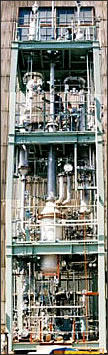
High quality is being demanded in many fields nowadays and so in order to satisfy that we developed a high-purity distillation system in collaboration with Ube industries, Ltd. and Kanto Chemical Co., Inc. The system is used to refine cleaning solutions for the semiconductor industry, medical materials, etc. of high purity (residual ion concentration: 0.01 to 1.0 ppb).
- Our High-purity distillation system provide our clients with high solvent recovery rate, almost 100%.
- The quality of the products/output from our system is very stable, which makes production management very easy, and easier than the conventional ion exchange resin method.
- No emission of waste brings our clients reduction of running cost for environmental measures.
- Our various devices minimize entrainment.
- To prevent the elution of metal, you could ask us the system made of Teflon.
- Our High-purity distillation system has been already proved for solvents that trigger very rapid decomposition reactions, such as hydrogen peroxide.
- Product guide
- Alcohol distillation
- Distillation equipment
- High-purity distillation system
- Membrane separation type solvent dehydration system
- Reactor
- Evaporative concentration equipment
- Coulter spray dryer
- Microwave treatment system
- Filter dryer
- OS filter (continuous vacuum rotating filter)
- Hydrocyclone (liquid cyclone)
- Thermal oil heater (heat medium boiler)
- Process air heater (air heater)
- Ammonia treatment system
- Catalytic deodorizing equipment for ammonia and VOC gas
- Stationary cryogenic storage tank
- Portable cryogenic container
- Cryogenic liquefied gas evaporator